
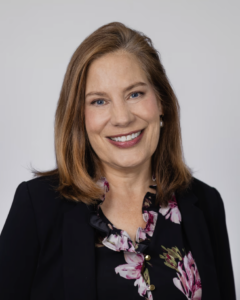
 Anne Trumbore is Chief Digital Learning Officer at the Sands Institute for Lifelong Learning at The Darden School, University of Virginia, where she is responsible for creating a strategy to expand access to world-class education and advance Darden’s mission of providing transformational learning experiences to learners globally. Drawing on experience establishing and leading Wharton Online and early-stage roles at Coursera, NovoEd, and Stanford’s Online High School, Anne has helped pioneer new forms of student-centered online education. She is the author of The Teacher in the Machine: A Human History of Education Technology (Princeton University Press, 2025) and was a 2025 Stanford Futures Fellow.
Anne’s work aligns closely with Learning Society’s mission to imagine more flexible, holistic forms of learning — and to align institutions toward them. We asked her about the future of higher education, how schools and employers can better collaborate to develop human talent, and what success metrics matter most for a learning society.
The following Q&A has been lightly edited for clarity:
What does organizing the life course around lifelong learning rather than schooling mean to you and your organization?
For colleges and universities, organizing life around learning rather than schooling is a collective opportunity to reimagine how we offer more education to more people across longer periods of time. It’s a once-in-a-lifetime opportunity to reinterpret the shared values of higher education: producing citizens with greater curiosity, an appreciation for learning, and an understanding of the historical, social, and cultural forces that have created our current moment. At the Sands Institute for Lifelong Learning at UVA Darden, we are working with employers and individuals who need short education “infusions” that they can immediately apply at work and in society. These short programs primarily focus on practical skills for leading people and oneself in times of change: critical capabilities for thriving in our turbulent times.
People are living and working into their 70s and 80s — and changing careers far more often than previous generations. How should this reshape how we think about education and training?
Every transition between careers, between work and school, or between time off and work carries real risk because of how we have incentivized universities and employers to develop talent. If we think of life in quarters, we currently invest heavily in the first, followed by almost no formal talent development in the second and third. Universities are subsidized to develop talent in the first quarter of life, while employers are not subsidized well to develop talent over the next two quarters. This needs to change so that the risks of transitions are borne by all who benefit: individuals, employers, schools, and society.
What’s one way that schools, employers and policymakers could better collaborate to develop human talent?
Each is a separate system designed to replicate itself. Until collaboration makes sense for each system, it simply won’t happen. So, how do we do that? For one, raise the level of dialogue to the national level and make the problem large enough so that each system becomes a part of the solution instead of just solving their own challenges.
Secondly, progress is still measured primarily in terms of life stages: most people are either students or employees and are rarely both simultaneously. But policy can help us reshape those incentives; for example, by offering tax breaks for employers who offer formalized talent development, developing employee-held data wallets so that learning at school and work can be recognized and shared, and providing universities with easier accreditation processes for short-term credentials.
Beyond graduation rates and test scores that informed policy analysis in the schooled society, what sorts of data and indicators should we develop to measure progress in the learning society?
First, we need to determine what society needs, and then develop the measurements to reflect indicators of progress toward these goals. AI has the potential to radically expand both what we can measure and how we do it. So we should think ambitiously about what capabilities citizens of a flourishing society demonstrate: creativity, collaboration, understanding, a collective sense of identity, generosity, learning agility — the list is long and deserves serious thought. It’s genuinely exciting to think about how we can use this new framing around learning to help people flourish and, by extension, create a healthier society.
If you could change one thing about how we invest in people’s talent and potential, what would it be and why?
Universities, employers, and policymakers need to share both data and risk with individuals in terms of developing human potential. Currently, the individual bears the risk of investing in their own talent, with significant penalties for getting it wrong: unsustainable student debt, underemployment, wasted time, money, and potential. Employers, universities, and policymakers all benefit when an individual gets it right; if they share in the wealth, they should share the risk as well.
Dialogues is a Q&A series featuring conversations with fellows, partners and experts across workforce development, higher education and philanthropy. Through this series, we aim to give our readers digestible insights into how leaders in these spaces are thinking about the pressing challenges of our times — and how a learning-oriented model of human capital development can come to fruition.

